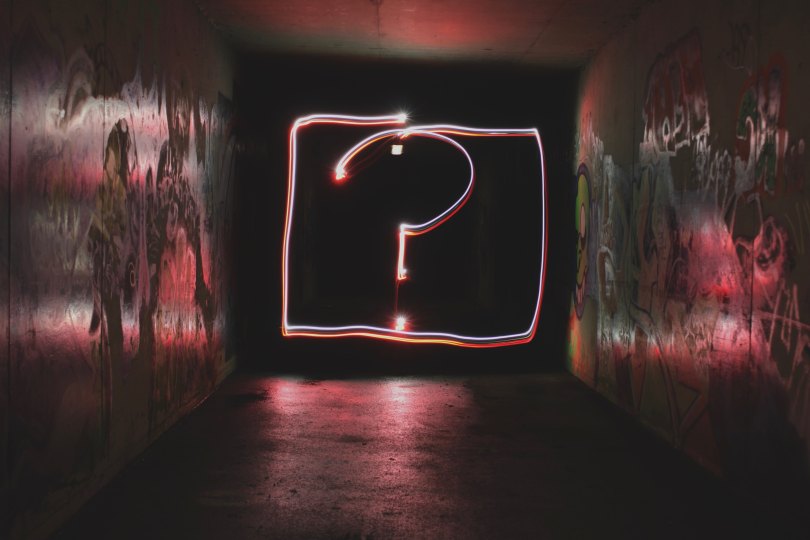
Recently, one thought has been popping up in my mind repeatedly. And it happens at all sorts of time – when driving, when walking, even when talking.
Not that I’m complaining though. In my somewhat routine life, I tend to forget a very important thing, maybe, even the most important thing. But I’m glad that these days, the thought has been staying fresh in my memory through repetition.
And that thought is:
I don’t know what I don’t know.
When we forget this simple fact, it can lead to a false sense of pride, of overconfidence, of reality even. Sounds over the top? Let’s see a couple of examples:
When driving a vehicle, perhaps you’ve encountered a situation where another driver suddenly does something unexpected (like cutting into your lane, or applying sudden brakes, or turning without any indication), and it is only because of your preventive actions that an accident is avoided. And many times that other driver is not even aware of what he did wrong, or how close he was to being in an accident.
This made me wonder: What if I was that other driver? I might think of myself as a very good driver, never having caused an accident. But I could very well be in that other driver’s place and could’ve caused any number of accidents. That fact that I didn’t, could just be due to luck or that other people were careful enough. But I wouldn’t know that, and will continue to live in my own fantasy world (where I’m a good driver). ‘I just don’t know what I don’t know.’
Here’s another one: Two employees might be up for the same promotion, which ultimately goes to one of them. The “victor” might think she’s better than the loser, and while that may very well be true, it’s also possible that the reality is something else entirely. Who is to say that it is not possible that the other person, the “loser”, had received the offer for promotion first, but she refused it due to some reason (maybe the promotion comes with too much stress, or requires extensive travel, etc. – things that the “loser” might not be okay with). Again, the “victor” doesn’t know what she doesn’t know.
***
One of the interesting things about this is that, if one is successful, one is even more prone to being afflicted by this syndrome. That might sound counterintuitive, but let me give one last example:
Let’s say that I’m a very successful person. I think it’s fair to say that my success can be attributed to my knowledge, experience, and beliefs. But since I have already been successful, when something contrary to my knowledge or beliefs surfaces, I’ll be reluctant to accept, or even acknowledge, that. And the more successful I have been with my current knowledge and beliefs, and the more contradictory the new information is to the things that have already worked for me, the more reluctant I will be to accept that new information. In this sense, success can actually give us a false sense of confidence in our knowledge.
In such situations, I’ll again do well to remember that ‘I don’t know what I don’t know’. Just because something has worked for me before, doesn’t mean there can’t be anything better than that. The first thing doesn’t preclude the second. Even though I was already successful with my existing knowledge, maybe I would’ve been even more successful if I had access to this “better” knowledge earlier.
***
Going through life, we form many opinions and beliefs, without even being aware of when, or how, we came to those conclusions. And sometimes, we can get carried away with these beliefs. We continue to have those beliefs till the time we experience something that makes us question them. And even after such an experience, we won’t easily give them up – we’ll try to justify the experience within the confines of our beliefs such that it doesn’t conflict with what we thought to be true. The experience has to be really “strong” to affect any sort of actual change in our beliefs.
That is why, even if someone told us, and rightly so, that we are wrong about something, we probably won’t believe them, because, based on what we do know, we are right. So, it is the other person who must be mistaken.
Not being able to see facts for what they are, and engaging in arguments over such facts, over who is right and who is wrong, is one of the reasons for much of the conflict in our lives.
And that is why, I think, it is very important that we always remember this: We don’t know what we don’t know.
I mentioned before that I’m glad to be continuously reminded of this. Why is that, you might ask. Because whenever I have this thought, it “resets” my perspective. I feel like I begin to see the world in a different way – in a better, clearer way.
With this thought in mind, when confronted with knowledge contradictory to my own, my approach to the conflict can change – from this: “How can I be proven wrong by this new knowledge? What can I do to prove my point?”, to this: “What is the real truth, and how do I get to it?”, and even this: “What other beliefs do I need to review, and change, in light of this new knowledge?”
If I can keep this thought at the back of my mind, then I can be more open to listening to others, to becoming better when the opportunity arises, to getting closer to the truth.
Of course, it is rarely easy to do so. First of all, we tend to keep forgetting this point. Even if we do remember it, it takes practice to implement this in our daily life. Plus, the benefits, if any, may not be evident immediately. So, we just have to stick it out – do what we can, when we can; believe in the idea, even if we don’t see any direct results.
***
The thought that I might, somehow or someday, reach a stage in life where my beliefs have been so hardened that I’ll forget, or even knowingly reject, the fact that ‘I don’t know what I don’t know’ is actually one of the things I fear. But, in the meantime, while I still believe in this idea, while this thought is still fresh in my mind, I am grateful to the powers that be for this insight.
Photo Credit: Emily Morter on Unsplash

 Echoes In The Ether
[…] we must always keep in mind that even though we may think we know ourselves, we could be wrong. We don’t know what we don’t know, and it’s entirely possible that we may have come to the wrong conclusions about ourselves. So, […]
LikeLike